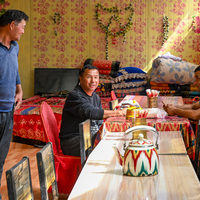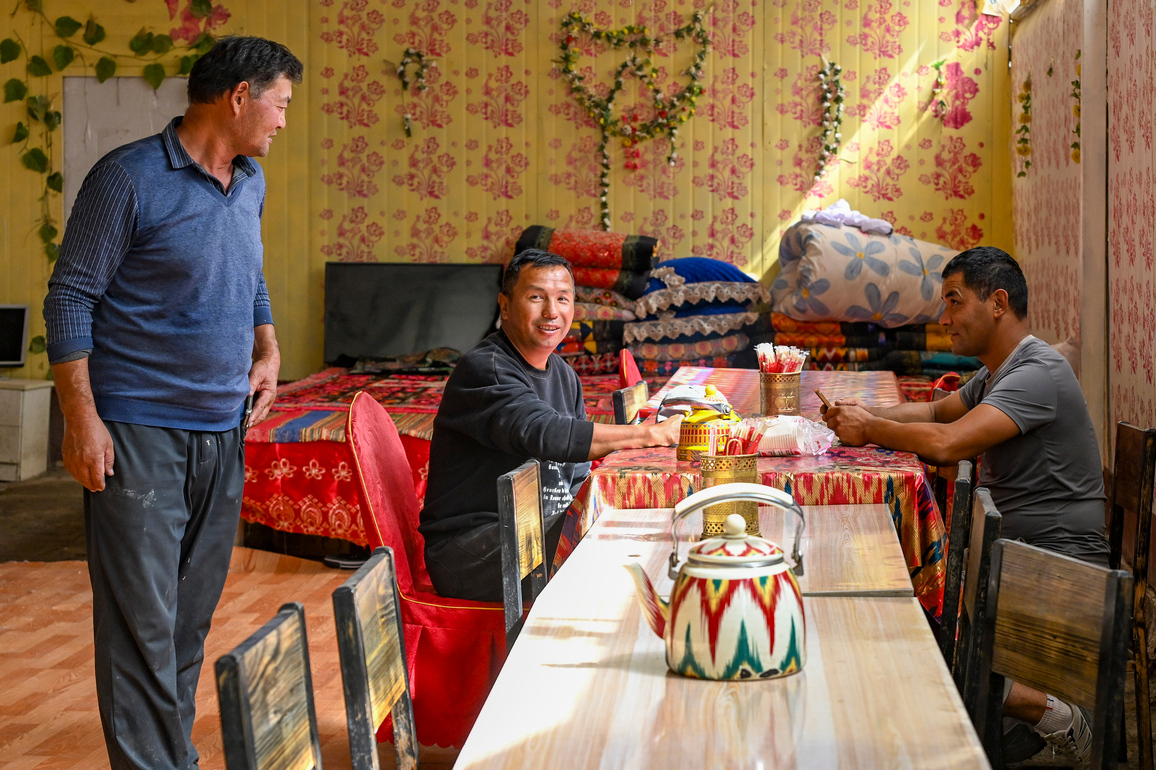
(250930) -- YULI, Sept. 30, 2025 (Xinhua) -- A villager (L) talks with guests at his homestay in Karquga Township of Yuli County, Mongolian Autonomous Prefecture of Bayingolin, northwest China's Xinjiang Uygur Autonomous Region, Sept. 20, 2025.
The Tarim River, which runs along the rim of the barren Tarim Basin, is China's longest inland river, spanning a drainage area of 1.02 million square kilometers. Winding along the northern rim of the Taklimakan Desert, the river nourishes approximately 15 million mu (1 million hectares) of populus euphratica forests flanking its middle and lower reaches, creating a "green corridor" that traverses the desert.
In previous decades, factors such as climate change and human activities put excessive pressure on water levels. By the early 1970s, the lower reaches had run dry, and the trees along its banks had all but disappeared.
Since 2000, Xinjiang has carried out a series of measures to address these issues. By now, the Tarim River has completed 26 rounds of ecological water diversion, releasing over 10 billion cubic meters of water cumulatively. Data from the project shows that the periodic release of water has alleviated ecological degradation in the target area. The groundwater level has risen, and the number and variety of animals and plants in the area have greatly increased.
"The river water has risen back, the populus euphratica trees have sprouted new branches, and the apocynum venetum has also grown up," said Eli Niyaz, a forest ranger in Yuli county.
Over the years, local people have been cultivating drought-resistant plants such as populus euphratica, apocynum venetum and oleaster to improve the environment. Monitoring data from the Chinese Academy of Sciences reveal that the vegetation species in the lower reaches of the Tarim River has increased from 17 to 46 types. Wildlife populations along the riverbanks, including Mongolian gazelles, foxes, little egrets, and wild ducks, have rebounded significantly.
The ecological restoration of the Tarim River basin is also enabling people who have lived along its banks for generations to benefit from the environmental improvement. (Xinhua/Chen Shuo)